
How Guild Wars 3 Plays
Movement, momentum, and the Gamescom combat loop on controller and keyboard.
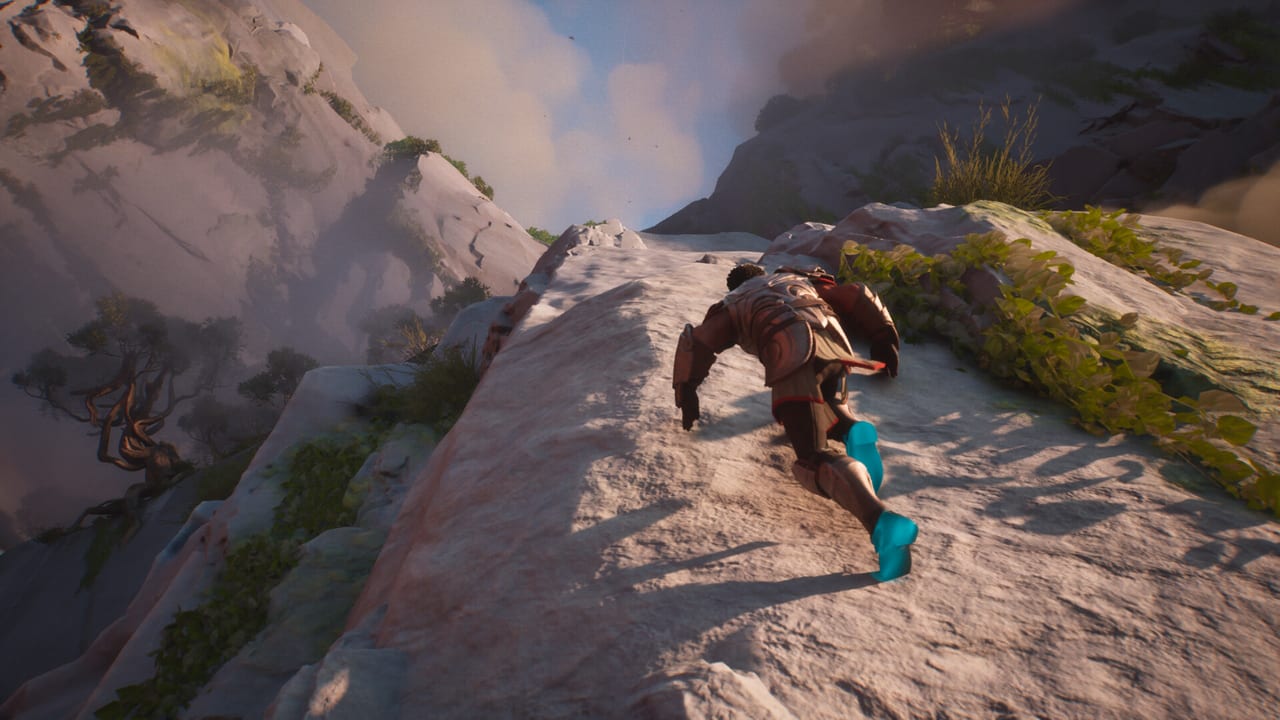
Guild Wars 3 is built so traversal and combat share one physics story. You do not dismount into a standstill, drop a glider into a standstill, or enter a fight by planting your feet. Speed you earn on a wall, a sprint, or a glide is supposed to still be there when the next action starts. That idea is the whole how-to-play lesson until the Fall 2027 beta lets us hold the stick ourselves.
The Gamescom 2026 slice was a hands-off alpha demo, mostly from a sword-and-shield Warrior, with a scythe Necromancer joining later. Ranger was confirmed in the Q&A rather than shown as a full playable pass. Colin Johanson (game director) and Kevin Stocker (combat lead) used the footage to sell two pillars: joy of movement, then combat that spends that movement. This page is the loop. The numbers and profession tricks live on momentum combat. If you have not wishlisted yet, go back to Getting Started.
Movement modes and the connective tissue
The demo opened on a verdant grassland with stone structures, a Vaelwarden camp as a miniature hub, and Arah visible in the distance. The player mantled ledges, ran up walls, leaped, and glided. Gliding looks related to Guild Wars 2’s glider, but it is powered by momentum: you can bank, dive, and hit a cliff face without dumping speed. From there the character mantled again. Sprint, jump, glide, wall-run, and mantle are not separate toys. They are modes that hand velocity to each other.
Stamina exists. Preview coverage described endurance pips that limit how long you can wall-run or glide. That matters more than a flavor bar: if stamina gates vertical movement, then the how-to-play skill is knowing when to spend height and when to land. Camps such as the Warden’s Watch outpost shown in the demo are where you are meant to regroup, talk, and adjust a build before heading back out. The giant spirit from the trailer, named as a Root Runner in previews, was present but not ridden in that slice. Your personal mount remains the Seeker, a Vael spirit you will actually use in the open world.
Colin Johanson’s own contrast is the useful one. In a typical MMO you ride, stop, glide, stop, press a combat ability, stop. Guild Wars 3 is trying to be the first MMO with a full transitional movement system. If that holds in the beta, the right way to play is to keep moving unless a tank build or a blocked doorway says otherwise. Jumping puzzles are not confirmed as a mode, but Johanson laughed about Guild Wars 2’s environmental artists still being around. Expect vertical maps, not hallway maps. Ancient Orr is being built as a more contiguous space with fewer loading screens than previous Guild Wars games.
The combat loop from the Gamescom demo
Combat uses an action camera. The preview put the character in the center of the screen with a reticle, enemy nameplates, and health bars. There was no tab-target list. Basic sword swings did baseline damage. Specific skills knocked enemies down or back and interrupted attacks. Location is a weapon: you can slam foes into walls to stun them, and they can do the same to you. Larger enemies only move if you cash in a lot of momentum. Kick skills can send targets off ledges. ArenaNet has not decided what happens to loot that falls off a cliff.
The first fight was a raptor pack. The Warrior’s aerial slam scaled with fall velocity: a stationary hop did little, a wall-run bomb did more damage in a wider radius. Elite skill Rampage charged during combat rather than sitting on a long cooldown. On activation it dealt damage and then granted faster attacks, stronger pushes, and higher jumps, which fed more momentum. That is the loop in one sentence: move to gain speed, spend speed on impact, spend an elite to gain more move, repeat.
The second space was a ruined Dhuum temple, appropriate for a timeline where Grenth has only recently deposed the old god of death. A Necromancer joined. The Warrior crouched with a shield and became a springboard so the Necromancer could enter from the air. That is a multiplayer combo, not a Guild Wars 2 combo field. Later, a Mavenburner-style veteran with a spirit-powered flamethrower had a backpack weak point; destroying the tank killed the enemy in an explosion. Spiders webbed the pair, cutting momentum and attacks, until fire skills burned the webs off. Johanson tied that directly to Guild Wars 1 build-making: bring the right skills for the enemy, especially in dungeons.
Three encounter pillars were named: positioning and terrain, weak points you need momentum to reach, and Guild Wars 1-style counterplay. Small enemies may use one pillar. Bosses and dungeons may mix all three. Party play is the design center even though the game is described as solo-friendly. Read momentum combat for Warrior, Necromancer, and Ranger specifics, then roles for tank, damage, and support language.
Controller versus mouse and keyboard
The Gamescom footage was controller-based. Skill icons sat on face buttons and shoulders. Johanson and Stocker said the game is being designed so a pad is not a watered-down PC layout. Many attacks are contextual: what you are doing (sprinting, airborne, blocking) changes what the button does, which is how they hope to keep build depth without a twelve-key action bar. Mouse and keyboard is still a first-class input. DualSense is supported; on PC Steam it is listed as USB only. Platforms covers storefronts, cross-play language, and that USB caveat.
Do not treat the Gamescom HUD as the shipping UI. ArenaNet said the preview interface was built for the showing and will be redesigned. The goal is less clutter than Guild Wars 2, more information pushed into the world (frozen enemies look frozen, fire looks like fire), and a UI that works on a television. If you are a Guild Wars 2 action-camera player, the demo will feel familiar. If you are a click-to-move tab-target player, expect to relearn camera, stamina, and aiming before the Fall 2027 beta.
What the demo did not show: menus, inventory, a build screen, guild UI, Seeker riding, cities at population, or a Ranger on camera. Progression and skill acquisition were promised for later talks. Open-world loadouts will likely be more flexible than dungeon loadouts; that is an interview hint, not a rulebook. Until the beta, the correct way to practice is mental: watch vertical lines in the trailer, notice when a slam comes from a wall, and read this page together with momentum combat instead of treating them as the same article.
Next: pick a first profession on the classes hub, confirm your storefront on Platforms, and sign up on the Fall 2027 Beta page if you have not already. The Guides Hub lists every sibling guide.
Frequently Asked Questions
Quick answers for Guild Wars 3 players waiting on the Fall 2027 beta.
Is Guild Wars 3 tab-target or action combat?
The Gamescom demo used an action camera with a reticle, not a tab-target list. Movement and aiming matter. See momentum combat for how professions spend that motion.
Can I play with a controller on PC?
Yes. Combat is designed for controller and for mouse and keyboard. DualSense on PC Steam is USB only. Details are on Platforms.
What is the basic combat loop?
Build momentum through sprint, wall-run, glide, or mantle, then spend it on impact, knockbacks, and aerial slams. Elite skills such as Warrior Rampage charge in combat. The deep dive is momentum combat.
Was the Ranger shown in the demo?
Not as a full playable pass. Colin Johanson confirmed Ranger in the Gamescom Q&A, with airborne slow-fall bow shots described. Warrior and Necromancer were on camera.
Should I treat the Gamescom HUD as final?
No. The preview UI is a placeholder and will be redesigned. Use Getting Started for what is actually locked, and watch Gamescom 2026 notes as more footage lands.